

64% Chose One AMHS Module; Here’s Why It Matters for Semiconductor Fabs
Welcome to the third edition of our newsletter. Building on insights from our recent AMHS poll, we explore where semiconductor fabs see the most value today. By partnering closely with our customers, we align AMHS solutions with their roadmaps to support both current operations and future expansion.
Automated Material Handling Systems (AMHS) form the backbone of modern semiconductor manufacturing. Designed to transport and manage wafers efficiently within a fab, AMHS plays a critical role in maintaining throughput, reducing contamination risks, and ensuring smooth, uninterrupted production flows.
However, AMHS is not a single solution- it is an ecosystem made up of multiple modules, each serving a distinct function within the fab environment. From high‑speed wafer transport to routing, every component contributes differently to the overall performance.
We asked a simple question on our LinkedIn Page, “Which AMHS module do you think adds the most value in a semiconductor fab? ”. The responses revealed not just preferences, but how the industry prioritizes productivity, scalability, and efficiency today.
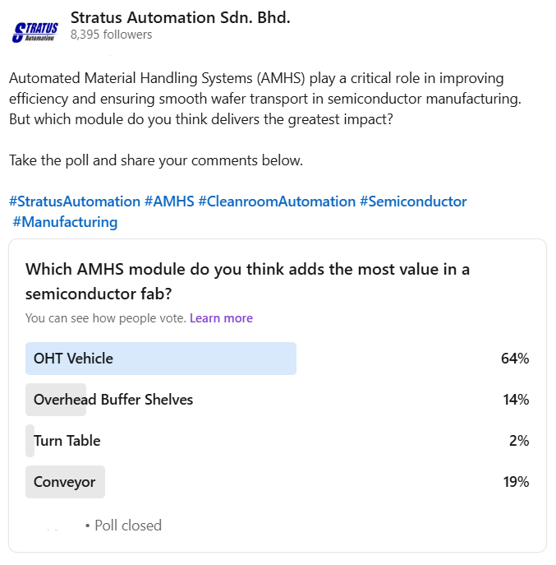
Why Overhead Hoist Transport (OHT) Leads the Way with 64%?
Overhead Hoist Transport (OHT) systems are widely perceived as the most value-adding Automated Material Handling System (AMHS) module, and many fabs consider OHT the default and preferred method for material movement across the production floor. OHT plays a critical role in enabling automated, precise, and cleanroom compliant handling of Work In Process (WIP). However, at Stratus Automation, we believe it is important to look beyond perception and evaluate how OHT is used within the broader AMHS architecture.
By design, OHT systems are meant to serve a very specific and high value function: loading and unloading WIP directly to and from process tools. This direct interaction with tools is where OHT delivers its strongest performance and operational benefit. Challenges arise when OHT is deployed as the primary transportation method across the entire fab floor. Each OHT vehicle is limited to carrying a single pod, box, or carrier at a time, which makes long distance or high volume transportation inherently inefficient. Rather than extending OHT beyond its intended role, Stratus Automation adopts a purpose-driven AMHS design philosophy.
By using each AMHS module for what it does best, fabs can achieve higher throughput, better scalability, and improved cost efficiency. In the end, effective AMHS design is not about choosing the most popular module, but about engineering a system where every component is deployed with clear intent, measurable value, and long-term performance in mind. As fabs face tighter cycle time requirements and increasing automation density, OHT systems have become the backbone of fab-wide material flow rather than just a transport layer.
Conveyors and Turn Tables: Supporting Efficiency and Stability
While OHT systems are often the most visible element in an AMHS, overall system performance depends on the coordinated role of multiple modules working together. Conveyors play an important part in transfers, where movement patterns are stable and predictable. Turn Tables, on the other hand, remain essential in space-constrained environments where it is intended to change movement direction by 90°. Together, these modules form a well designed AMHS that supports smooth material flow and sustained throughput.
Stratus approaches AMHS design where these modules are engineered to work in harmony rather than compete in function. This balanced architecture improves overall traffic efficiency, enhances tool availability, and supports scalable production demands. Every module is treated as a key contributor to performance, allowing Stratus to deliver hybrid AMHS solutions that are resilient, efficient, and optimised for real-world operations.
Where Stratus Automation Makes the Difference
At Stratus Automation, we believe AMHS value doesn’t come from technology alone- it comes from collaboration. By working closely with our customers, we align AMHS designs with their fab roadmaps and expansion plans, tailor system configurations to meet real operational constraints, and deliver solutions that perform reliably today while remaining future‑ready. This collaborative approach ensures that every module- whether OHT, conveyor, or buffer, works together as part of a high-performance system.
AMHS decisions are becoming strategic business decisions, and fabs are prioritising systems that deliver speed, scalability, and long-term operational resilience. The highest-performing fabs aren’t defined by a single AMHS module- but by how well each component is integrated, optimised, and aligned with future growth.
Access our latest 2026 brochure for detailed information and insights.